
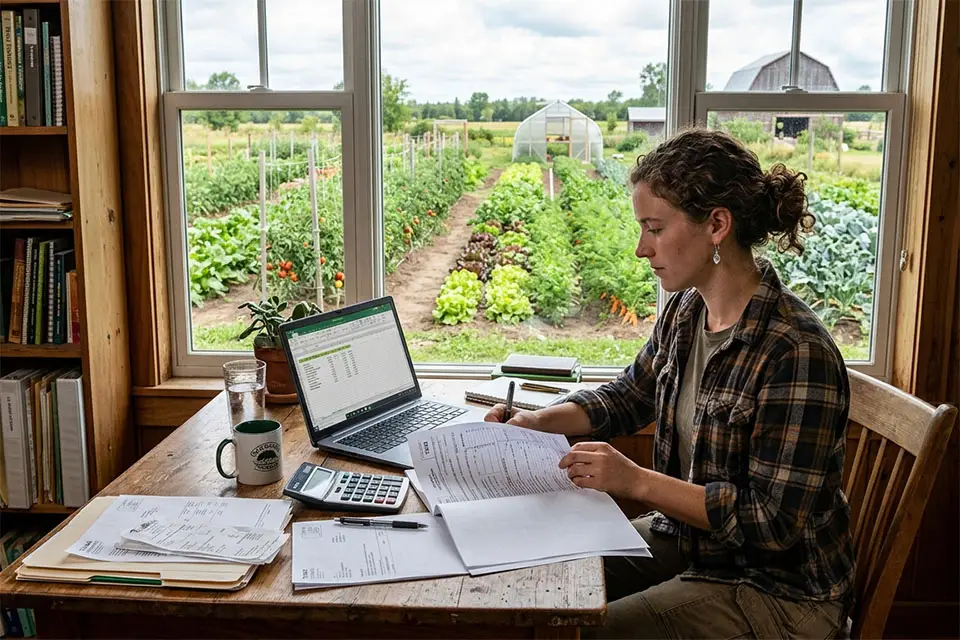
Farming income tax in Canada is governed by CRA under rules that differ significantly from standard business taxation. Canadian farmers file using Form T2042 (Statement of Farming Activities), and the deadlines split into two dates: the filing deadline is June 15, but any tax owed must be paid by April 30 to avoid interest charges. That split deadline catches many farmers off guard every year. This guide walks you through income classification, accounting methods, deductions, and filing requirements so you can keep more of what you earn.
There are important considerations for small farms and market gardeners versus large-scale farms when it comes to taxes in Canada, including differences in tax obligations, available deductions, and government support programs tailored to each type of operation.
What counts as farming income for tax purposes?
The CRA defines farming income as revenue from tilling the soil, raising livestock, operating a market garden, or running an orchard, among other agricultural activities. That definition matters because it determines which deductions you can claim and how your losses are treated.
The CRA places farms into three categories, and each one carries different tax treatment.
Full-time farms are operations where farming is your primary source of income and livelihood. Full-time farmers can deduct 100% of their farm losses against other income in the same year. They also have access to the widest range of deductions and credits.
Part-time farms are operations where farming is a secondary income source. Part-time farmers can claim a maximum of $17,500 in losses per year against other income. Those losses can be carried back three years or forward 20 years, but only against farming income. That restriction is a meaningful limitation if you have a bad crop year and significant off-farm income.
Hobby farms are the most restricted category. If the CRA determines your farm has no reasonable expectation of profit, it classifies the operation as a hobby. Hobby farm losses cannot be deducted at all. This classification is a real risk for small or newly established operations, so keeping records that demonstrate a genuine profit motive is critical.
The distinction between part-time and hobby farm is not always obvious. Factors the CRA considers include your history of profit and loss, the time you commit to the operation, and whether you have the expertise to make it profitable. Consistent record-keeping and a written business plan go a long way toward defending a part-time classification.
Cash vs. accrual accounting: which method suits your farm?
Canadian farmers have a unique advantage that most other types of businesses do not. The Canada Revenue Agency (CRA) allows farmers to choose between two different methods of accounting for their income and expenses: the cash basis, where transactions are recorded when cash is received or paid, and the accrual basis, where transactions are recorded when they are earned or incurred. This flexibility helps farmers select the accounting method that best aligns with their cash flow and operational practices, potentially simplifying their tax reporting and financial management.
| Feature | Cash basis | Accrual basis |
|---|---|---|
| Income recorded | When cash is received | When earned, regardless of payment |
| Expenses recorded | When cash is paid | When incurred, regardless of payment |
| Best for | Smaller farms, simpler operations | Larger farms with significant receivables |
| Tax timing control | Higher flexibility | Lower flexibility |
| Inventory treatment | Optional Inventory Adjustment applies | Mandatory Inventory Adjustment applies |
Most farmers use cash basis accounting because it gives you direct control over the timing of income and expenses. If you delay selling a storage crop until January, that revenue lands in the next tax year. That kind of timing flexibility is a genuine planning tool.
The accrual method records income when it is earned and expenses when they are incurred, regardless of when cash changes hands. Larger operations with significant accounts receivable or payable often find accrual accounting gives a more accurate picture of annual performance.
Inventory adjustments affect both methods. The Optional Inventory Adjustment lets cash-basis farmers include unsold inventory in income to increase a loss year’s income (useful for smoothing income across years). The Mandatory Inventory Adjustment prevents farmers from reporting a loss greater than the value of their closing inventory.
Pro Tip: If you are on cash basis and expect a high-income year, consider prepaying expenses like seed, inputs, equipment, or insurance premiums before December 31. That moves deductible costs into the current tax year and reduces your taxable income.
What farm tax deductions should you be claiming?
Farm tax deductions in Canada extend well beyond the obvious inputs. Allowable deductions include utilities, fuel, professional fees, and vehicle costs when you document the business-use proportion. Many farmers leave money on the table by missing these categories.
Common deductible expenses include:
-
Feed, seed, fertilizer, and pesticides used in the farming operation
-
Fuel and oil for farm machinery and vehicles used for farm purposes
-
Electricity and heating for barns, greenhouses, and other farm buildings
-
Repairs and maintenance on farm buildings and equipment
-
Professional fees including accounting, legal, and farm management consulting costs
-
Insurance premiums on farm property and livestock
-
Interest on farm loans used to finance the operation
-
Home office expenses if a portion of your home is used exclusively for farm administration
Vehicle expenses deserve special attention. You can deduct the business-use portion of vehicle costs, including fuel, insurance, repairs, and depreciation. Accurate vehicle logs are critical to justify those claims. The CRA expects a log that records the date, destination, purpose, and kilometres driven for each farm-related trip. Without it, the entire vehicle deduction is at risk during an audit.
Pro Tip: Use a dedicated notebook or a simple phone app to log every farm-related trip throughout the year. Reconstructing a year’s worth of driving from memory at tax time is unreliable and a common audit trigger.
Farmers often overlook professional fees and utility costs as deductible expenses. If you hire an agronomist, a farm consultant, or an accountant who specialises in agriculture, those fees are fully deductible. The same applies to the electricity that runs your farm infrastructure (but not your farm’s personal dwelling).
How to report farming income using Form T2042
Form T2042, the Statement of Farming Activities, is the core document for reporting farm income and expenses to the CRA. You attach it to your personal income tax return (T1) each year. The form organises your gross farming income, deductible expenses, and net farming income or loss into a clear structure that feeds directly into your overall tax return.
Completing Form T2042 accurately requires these steps:
-
Gather all income records. List every source of farming revenue, including crop sales, livestock sales, government programme payments, and custom work income. Do not omit AgriInvest withdrawals or AgriStability payments, as these are taxable.
-
Categorise your expenses. Match each expense to the correct line on the form. The CRA uses specific categories, and placing an expense in the wrong line can trigger a review.
-
Calculate your CCA. Use Area A on page 5 of the T2042 form to calculate Capital Cost Allowance on farm buildings, equipment, and vehicles. Attach this schedule to your return.
-
Apply inventory adjustments. If you use cash basis accounting, determine whether the Optional or Mandatory Inventory Adjustment applies and record it on the form.
-
Transfer the net amount. Your net farming income or loss from T2042 flows to line 14100 of your T1 return.
Incorporated farms do not use Form T2042. A farm corporation files a T2 corporate income tax return instead, and the rules around deductions and loss treatment differ from personal returns. Partnerships report farming income on a T5013 Partnership Information Return.
Aligning your farm accounting with Business Risk Management programmes like AgriStability and AgriInvest is worth the effort. Both programmes use your tax-reported farming income as the basis for calculating support payments. If your tax records and programme records do not match, you risk reduced payments or compliance issues with both the CRA and Agriculture and Agri-Food Canada.
Key takeaways
Canadian farmers who understand their farm classification, choose the right accounting method, and claim every eligible deduction will consistently pay less tax and face fewer audit risks.
| Point | Details |
|---|---|
| Know your farm classification | Full-time, part-time, and hobby farms each have different loss deduction rules. |
| Meet both deadlines | File by June 15 and pay any balance owing by April 30 to avoid penalties and interest. |
| Choose your accounting method carefully | Cash basis gives income-timing flexibility; accrual suits larger operations with receivables. |
| Claim all eligible deductions | Utilities, professional fees, and vehicle costs are frequently missed but fully deductible. |
| Use CCA and AII strategically | Accelerated depreciation in the year of equipment purchase can significantly cut your tax bill. |
Why farm tax planning deserves more than a once-a-year conversation
Working with Canadian farmers over the years, I have seen one pattern repeat itself more than any other: farmers who treat tax as a year-end task rather than a year-round discipline consistently pay more than they need to. The cash basis method gives you real flexibility to time income and expenses, but that flexibility only works if you are paying attention in October and November, not February.
The $1 million Lifetime Capital Gains Exemption on qualified farm property is one of the most valuable tax benefits available to any Canadian, and yet many farmers do not structure their affairs to access it fully. Selling farmland or quota without proper planning can mean losing a significant portion of that exemption to avoidable tax.
Another common occurrence is the blurring of personal and business expenses. A truck used for both farm deliveries and family errands is not a 100% farm deduction. Claiming it as such is the kind of thing that triggers an audit and erases years of legitimate deductions in one review. Keeping clean records is not just good practice. It is your best defence.
Be sure to find an accountant who works specifically with agricultural clients. A generalist will know the T2042 form. A farm-savvy accountant will know how to align your AgriStability reporting with your tax return, plan your CCA claims around equipment purchases, and time sales across fiscal years. That specialisation pays for itself
FAQ
What is Form T2042 used for?
Form T2042 is the CRA’s Statement of Farming Activities. You use it to report all farming income and deductible expenses on your personal T1 tax return each year.
What is the tax filing deadline for Canadian farmers in 2026?
Self-employed farmers must file their returns by June 15, but any balance owing must be paid by April 30 to avoid interest charges.
Can part-time farmers deduct all their farm losses?
No. Part-time farmers can deduct a maximum of $17,500 in farm losses per year against other income. Unused losses carry back three years or forward 20 years, but only against farming income.
What accounting method should Canadian farmers use?
Most Canadian farmers use cash basis accounting because it allows flexibility in timing income and expenses. Larger operations with significant receivables may benefit from accrual accounting instead.
What is the Lifetime Capital Gains Exemption for farm property?
The Lifetime Capital Gains Exemption allows Canadian farmers to shelter up to $1 million in capital gains on the sale of qualified farm property from income tax, making it one of the most significant tax benefits available to farm operators.